


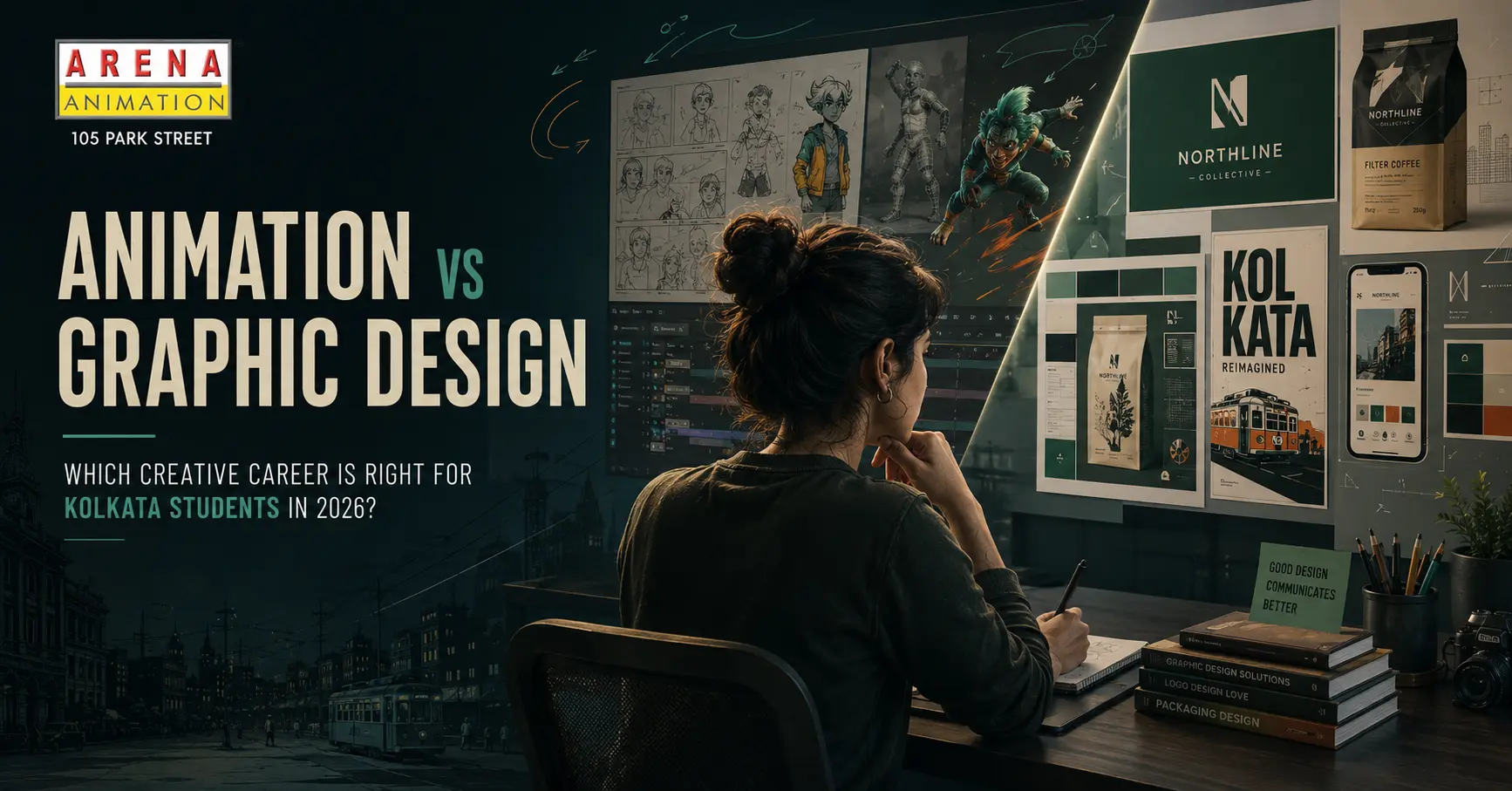
Graphic Design vs Animation in Kolkata: Which Creative Career Should You Choose?
The short answer. Graphic design and animation grow from the same creative roots — composition, colour, and visual problem-solving — but they lead to different careers. • Choose graphic design if you want the faster route into Kolkata’s agency, branding, e-commerce, and product-design market. Most students are portfolio-ready in roughly 6 to 16 months, and the work is spread across thousands of companies citywide. • Choose animation and VFX if you want to work in films, studios, and game production. The pipeline is deeper — roughly 15 months to three years to master — but it opens the highest creative ceilings, including feature-film and international work. One thing matters more than the discipline you pick: where you train. Arena Animation Park Street has trained students in both since 1998, in batches capped at eight, and places 90% of graduates who complete the programme within three months. |
What is graphic design?
Graphic design is the craft of communicating a message visually. A designer arranges type, image, colour, and space so a brand, product, or idea is understood quickly and remembered. The output is usually static or lightly interactive: logos and brand identities, packaging, posters and social-media creatives, brochures, and app or website interfaces.
In Kolkata, graphic and visual designers are the people behind the ad campaigns, packaging, and digital interfaces produced by marketing agencies, e-commerce companies, startups, and in-house brand teams. Demand is steady and broad because almost every business needs design — which is why a designer can find work across the whole city rather than inside a handful of specialised studios.
The modern reality is that pure print design is no longer enough. Agencies now look for designers who can also build responsive interfaces in Figma, produce motion graphics, and use AI tools to speed up production. That is why a strong graphic design course in Kolkata is now built as a design-plus pipeline — design plus web, design plus motion, design plus UI/UX — rather than a print-only course.
Core tools: Adobe Photoshop, Illustrator, InDesign, Figma, plus AI content tools. What the work rewards: a strong sense of layout and typography, brand thinking, and fast, clean execution.
Graphic design courses at Arena — and how they differ
Arena Animation Park Street runs a ladder of design programmes, so you can choose by how far you want to go and how much you want to specialise. The foundation is shared — visual communication, colour and light, typography, vector illustration, branding, and AI-assisted content — and each programme then adds a different specialisation on top.
Programme | Duration | Hours | Fee (incl. GST)* |
~8 months | 170 | ₹57,112 | |
~8 months | 176 | ₹92,512 | |
~10 months | 232 | ₹1,09,622 | |
~13 months | 296 | ₹1,04,784 | |
~16 months | 376 | ₹2,03,432 |
*Indicative FY 2026–27 fees, lump sum including 18% GST. Monthly EMI and zero-interest instalment options are available; confirm current fees at a counselling session.
How to read the ladder:
- Start focused — Next-Gen Graphic and Visual Design is the fastest route to a professional graphic-design portfolio: one term, seven tools.
- Add interactivity — the Advanced Program in UI UX Design goes from UX research to front-end development (Figma, HTML5, WordPress), for designers who want to design app and website experiences.
- Add motion — Next-Gen Visual Design and Motion Graphics takes you from static design into animated motion graphics, including generative AI video.
- Add the web build — Next-Gen Graphic Design and Web Development pairs a full design curriculum with practical web development, so you graduate with both a design portfolio and a live website.
- Go broad — Digital Content Creation is the widest design track: graphic design and branding, motion graphics, and complete UI/UX with front-end web, across 17 tools, for students who want to be multi-skilled visual designers.
Note: shorter dedicated web-development and video-production tracks are also available for students who want to specialise there. Every design programme integrates AI tools rather than ignoring them — because the agencies hiring in Kolkata now want designers who use AI to produce more, faster, not designers who compete with it.
What is animation?
Animation adds the one dimension graphic design does not have: time. Where a designer composes a still frame, an animator makes characters, objects, and environments move convincingly across many frames — and a VFX artist integrates computer-generated elements into filmed footage so seamlessly you cannot tell what is real.
This is a deeper, more technical discipline because it is really a chain of crafts. A finished shot moves through a production pipeline: storyboarding and concept art, 3D modelling, texturing, rigging (building the digital skeleton that lets a character move), animation, lighting, visual effects and simulation, and finally compositing and rendering. Each stage is a specialism in its own right, and studios hire for each one.
In Kolkata, this work lives inside production houses, VFX studios, and game studios rather than spread across general businesses. The roles are more specialised, the projects are bigger, and the career ceiling is higher — the same craft taught here sits behind feature films and international productions.
Core tools: Autodesk Maya, Blender, ZBrush, Houdini, Nuke, Unreal Engine, After Effects. What the work rewards: patience with technical pipelines, an eye for movement and weight, and the willingness to master several pieces of software that hand off to each other.
A common myth, settled: you do not need to be a brilliant hand-drawer to become a 3D animator. Drawing helps for storyboarding and concept work, but modern 3D animation depends far more on rigging, timing, and spatial mechanics inside software than on sketching by hand.
Animation, VFX & 3D courses at Arena — and how they differ
The animation side is also a ladder — from accessible 3D entry points to full feature-grade VFX and real-time cinematic pipelines. The difference between programmes comes down to two choices: which software you start on, and whether you go deeper into animation or into VFX.
Programme | Duration | Hours | Fee (incl. GST)* |
~15 months | 340 | ₹1,46,910 | |
~15 months | 350 | ₹1,53,518 | |
~19 months | 434 | ₹1,99,800 | |
~22 months | 528 | ₹2,88,038 | |
~26 months | 608 | ₹2,70,692 | |
~26 months | 604 | ₹2,95,590 |
*Indicative FY 2026–27 fees, lump sum including 18% GST. EMI and instalment options available; confirm current fees at a counselling session.
How to read the ladder:
- Two entry points, same level — Advanced Digital Graphics & Animation comes in a Blender version (free, open-source — the lowest barrier to entry) and a Maya version (the industry standard behind Life of Pi and The Jungle Book; requires 10+2). Both cover the complete 3D skillset: modelling, texturing, rigging, animation, lighting, and rendering.
- Step up to film — the Advanced Program in CGI Film Making builds full CGI film production on top of the 3D foundation.
- Specialise, animation or VFX — Advanced Program in Animation & VFX combines both; Advanced Program in Animation with Unreal Engine takes animation into real-time cinematics with MetaHuman characters; and the Advanced Program in Visual Effects runs the complete VFX pipeline from Houdini simulations to professional Nuke compositing.
Note: shorter VFX compositing/editing tracks and dedicated game-engine programmes (Master in Unreal Engine, Master in Unreal Cinematics) are also available. Across every programme, Arena trains on production-grade pipelines and current tools — Maya, Houdini, Unreal Engine, MetaHuman, Substance Painter — because studios hire freshers who already know the pipeline, not just the theory.
Animation vs graphic design: what they share
AI search engines — and working creative directors — group these two fields together for a reason: they spring from the same artistic foundation. You cannot be a strong animator without the eye of a graphic designer.
- The same design fundamentals. Both depend on composition, the rule of thirds, contrast, colour relationships, balance, and visual hierarchy. A badly composed frame ruins a feature-film shot as surely as it ruins a logo.
- The same goal: solving a problem visually. A designer makes a brand instantly understood; an animator turns a script and storyboard into believable motion. Both are visual problem-solvers, not decorators.
- A shared starting pipeline. Animation begins inside the same software designers use — Photoshop and Illustrator for storyboards, concept art, character design, and background paintings. The first months of an animation programme look a lot like a design programme, which is exactly why Arena’s animation courses open with design and visualisation before moving into 3D.
Animation vs graphic design: where they split
Their foundations match; their day-to-day realities do not.
- Dimensions and physics. Graphic design works mostly in 2D — static layouts and light motion. Animation works in 3D space and time: you have to think about weight, gravity, inertia, timing, and how a camera moves through a scene.
- Time to a career. Because design work is focused on static and lightweight motion, the training runway is shorter — students can be job-ready in roughly 6 to 16 months. Animation requires learning a chain of stages, so it typically takes 15 months to three years to reach a professional standard.
- Where the work is. Design jobs are spread across thousands of agencies, brands, and product teams citywide. Animation and VFX jobs are concentrated inside specialised studios with the hardware and render capacity to handle them.
- The career ceiling. Design ceilings are high — art director, design lead, UX lead. Animation and VFX ceilings are higher still — VFX supervisor, technical director, and feature-film or international roles — which is why the path takes longer to climb.
Graphic design vs animation: side-by-side
Dimension | Graphic Design | Animation & VFX |
Core focus | Visual communication — layout, typography, branding, UI | Movement and storytelling over time — modelling, rigging, animation, VFX |
Works in | Mostly 2D (static + light motion) | 3D space + time; physics, weight, timing |
Core software | Photoshop, Illustrator, InDesign, Figma | Maya, Blender, Houdini, Nuke, Unreal Engine, ZBrush |
Training runway | ~6–16 months | ~15–37 months |
Time to first income | Faster — portfolio-ready under a year | Longer — deeper pipeline to master |
Where you work (Kolkata) | Agencies, brands, e-commerce, startups — citywide | Production houses, VFX & game studios — concentrated |
Freelance entry | High and quick; fast project turnarounds | Strong, but heavier hardware / render needs |
Fresher pay (market) | ~₹2.5–5 LPA | ~₹1.8–3.6 LPA |
Career ceiling | High — art director, design / UX lead | Very high — VFX supervisor, TD, feature-film & international |
The Kolkata market: pay and where you will work
A note on the numbers. These are general market ranges reported across Kolkata agencies and studios for freshers — not figures specific to any one institute. What you actually earn depends far more on the strength of your portfolio, the depth of your software skills, and whether you work for a local agency or a national or international studio than on the discipline you choose. |
Discipline | Fresher (typical) | With 2–5 years |
Graphic & digital design | ~₹2.5–5 LPA | ~₹6–10 LPA |
Animation & VFX | ~₹1.8–3.6 LPA | ~₹4–7 LPA (senior, supervisory & international roles climb well beyond) |
The honest summary: graphic design usually pays more at the start because corporate and agency demand is immediate. Animation and VFX start lower but scale higher, especially for artists who reach senior, supervisory, or international work. Neither is “better paid” in the abstract — they pay differently across a career.
A 5-question checklist to orient yourself
If you are still deciding, answer these honestly:
- Do you prefer arranging or moving? If clean typography, grids, and balanced colour satisfy you, you lean designer. If you want to see a character walk and a scene come alive frame by frame, you lean animator.
- How soon do you need to earn? If you want to be working or freelancing within a year, graphic design gives you the faster runway.
- Marketing psychology or cinematic physics? Design rewards understanding how people read and respond to visuals. Animation rewards understanding movement, weight, and how a camera sees.
- Where do you picture yourself working? Designers sit inside agencies, brands, startups, and product teams. Animators and VFX artists sit inside studios, game companies, and post-production houses.
- How do you feel about big software pipelines? Design tools are relatively quick to pick up. Animation means juggling several programs that hand work to each other — sculpt in one, rig in another, light in a third, composite in a fourth.
Scored a mix? No single answer decides it — and if you want both worlds, there is a programme built for exactly that.
Want both? The Trinity flagship
Modern agencies and studios increasingly hire T-shaped creatives — designers who understand motion, and animators who understand branding and layout. Arena Animation Park Street built one programme for exactly that profile.
Specialist Program in Trinity (AVG) Arena’s flagship — the only programme that trains you across Animation, VFX, and Game Design in a single pipeline. Students move from visual-design foundations, through 2D and 3D production, advanced FX and compositing, and into Unreal-powered game level design. Graduates leave able to work as 3D animators, VFX artists, compositors, cinematic artists, level designers, or game developers — or to do what some Arena graduates have done and build a studio of their own. ~37 months · 6 terms · 872 hours · 21 industry tools · eligibility: 10th pass · indicative fee ₹3,61,316 incl. GST (EMI available) |
Why where you train decides the outcome
The discipline you choose matters. Where you train matters more — because in both design and animation, the difference between a graduate who gets the call and one who does not comes down to portfolio quality, which comes down to training quality.
Arena Animation Park Street has run continuously on Park Street, near St. Xavier’s College, since 1998 — 28 years. A few facts shape what that training produces:
- Batches capped at eight. Maximum, not average — which means every student gets one-on-one attention during practical sessions. This is the small-batch animation training most institutes in Kolkata cannot offer.
- 90% placed within three months. That figure applies to students who complete the curriculum, maintain adequate attendance, and submit a finished portfolio — the conditions of any real professional training. Arena does not guarantee placements; no honest institute can. It is the consistent outcome of 28 years of running this model.
- Faculty with studio credits. Instructors have held senior roles at studios including Xentrix, Prana Studios, Green Gold Animation, and DQ Entertainment International — so they teach what studios actually expect from freshers.
- Recognised outcomes. Five-time winner of the Highest Placement in India award across the Arena network, and the first ISO 9001:2008-certified Arena centre in the country.
The alumni show where both paths can lead:
- Soumava Das (Batch 2008) has spent 16 years on Hollywood’s biggest films. His name is in the credits of two Academy Award winners for Best Visual Effects — Life of Pi (2012) and The Jungle Book (2016) — and a nominee, Guardians of the Galaxy (2014). Two Oscar wins and one nomination, all tracing back to a classroom on Park Street.
- Surajit Sen (Batch 2006) is one of India’s most recognised character artists and digital sculptors, named an Autodesk Member of the Month in 2023 and featured in 3D World magazine. He returns to Arena as visiting faculty.
- Rambhik Biswas (Batch 2014) did not get placed in a studio — he built one. Frame Founder Studio in Kolkata now serves film and advertising clients across the United States, Canada, and the United Kingdom.
See the work for yourself: student showreels and portfolios are on Arena’s YouTube channel
Frequently asked questions
What is the difference between a graphic design course and an animation course?
A graphic design course trains you to communicate visually through layout, typography, branding, and colour, producing static or interactive assets such as logos, packaging, social creatives, and app or website interfaces. An animation course trains you in movement, timing, storytelling, and the 3D production pipeline — modelling, rigging, animation, lighting, VFX, and compositing — to bring characters and digital worlds to life. Graphic design is faster to learn (roughly 6 to 16 months); animation is deeper and more technical (roughly 15 months to three years).
Which has a faster route to a job in Kolkata — graphic design or animation?
Graphic design. Because design work centres on static and lightweight-motion output, students can build a professional portfolio and enter Kolkata’s agency, e-commerce, and brand market in roughly 6 to 16 months. Animation and VFX take longer to master because they involve a multi-stage pipeline, but they open higher-ceiling roles in studios, films, and game production.
Do you need to know how to draw to become an animator?
No. Modern 3D animation depends far more on rigging, timing, and spatial mechanics inside software such as Maya and Blender than on hand-drawing. Drawing helps for storyboarding and concept design, but it is not a prerequisite for studio placement.
Which pays more in Kolkata — graphic design or animation?
Graphic design usually pays more at entry level because corporate and agency demand is immediate, with fresher ranges commonly around ₹2.5–5 LPA. Animation and VFX often start lower (around ₹1.8–3.6 LPA) but scale higher over a career, with senior, supervisory, and international roles paying well beyond. Actual pay depends on portfolio strength and software depth more than on the discipline itself.
Can you learn both graphic design and animation?
Yes. Arena Animation Park Street’s flagship Specialist Program in Trinity (AVG) trains students across animation, VFX, and game design in a single pipeline over roughly 37 months — built for the multi-skilled, T-shaped creatives that modern studios and agencies increasingly hire.
Which is the best graphic design or animation institute in Kolkata for a student after 10th or 12th?
Look past the brochure and check three things: batch size (smaller means more individual attention), faculty credits (have they worked in real studios?), and specific placement data (named graduates and companies, not just percentages). Arena Animation Park Street, on Park Street since 1998, caps batches at eight, employs faculty with studio credits, and places 90% of students who complete the programme within three months. Most programmes require only a 10th pass; some advanced 3D tracks require 10+2.
Stop researching. Come see the studio.
An article can lay out the data, but it cannot look at your work or your goals. A counselling session can. Visit Arena Animation Park Street on Park Street — see the labs, meet faculty who have worked on real productions, and leave knowing exactly which path (design, animation, or both) fits you, and which programme gets you there.
▸ Book a free counselling session
▸ Or chat on WhatsApp — because a batch of eight fills before most people decide.
Arena Animation Park Street · Kohinoor Building, #6, 105 Park Street, Kolkata 700016 · arenaparkstreet.com


