


Arena Animation Park Street Has Opened a Professional Green Screen Studio
What the new chroma key setup means for VFX students — and why shooting your own footage makes a stronger portfolio than borrowing stock clips.
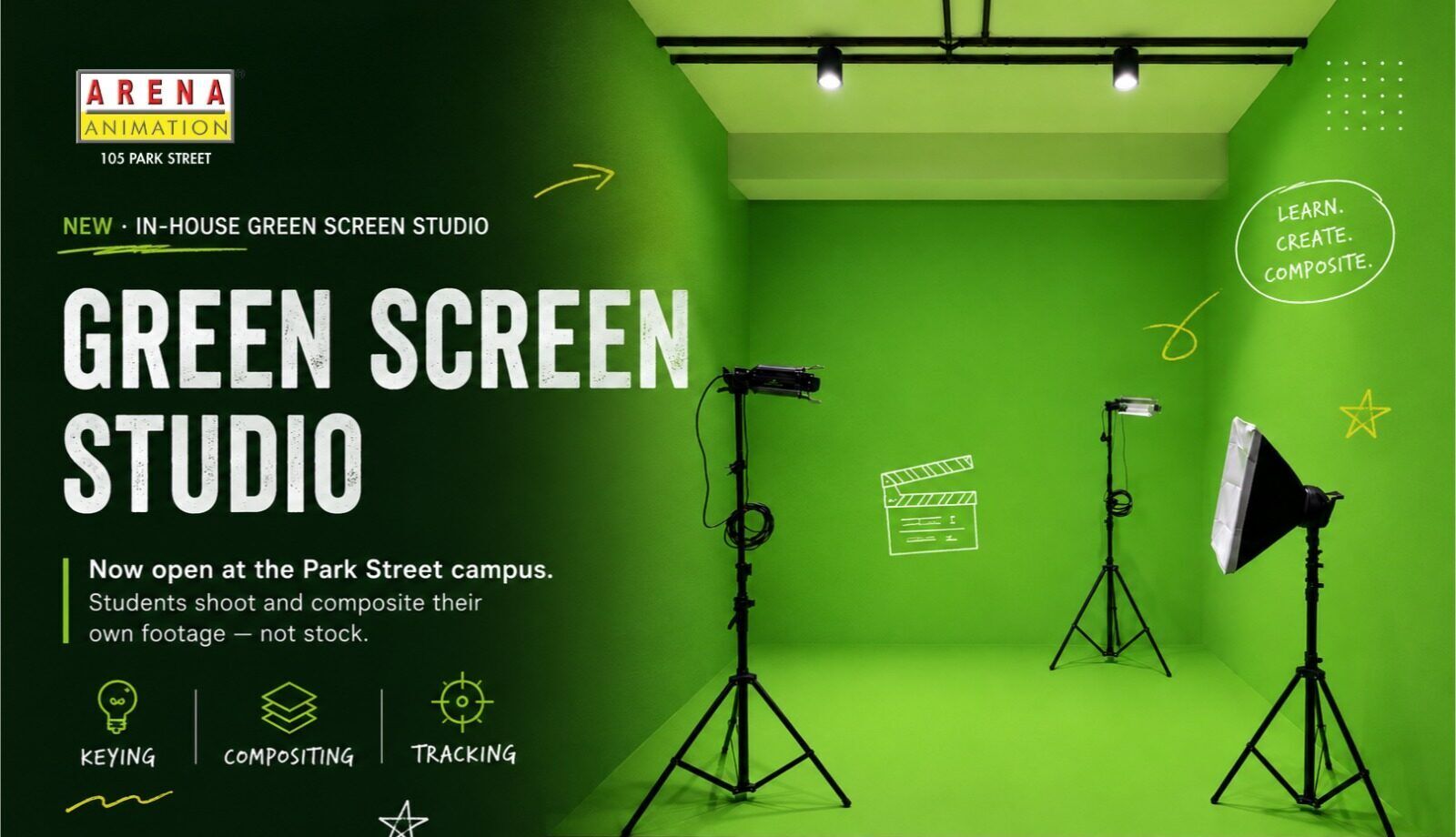
Arena Animation Park Street has built a professional green screen studio at its Park Street campus. Students on the VFX and motion programmes can now film their own footage and composite it themselves, rather than learning the technique on stock clips. It is one of the few in-house green screen studios at a training institute in Kolkata.
If the term is new to you, here is what a green screen is, and why having one on-site genuinely changes what a student can do.
In short: A green screen is a flat green backdrop that software can detect and swap out for any other image — a technique called chroma keying. It is how someone filmed in a studio can appear to stand in a different city, a 3D environment, or a scene that was never really there. For a visual effects student, the point is the portfolio: a shot you filmed and composited yourself proves far more than one stitched together from stock footage. |
What a green screen actually does
A green screen works on a simple principle. The camera records a subject against an even, strongly coloured green backdrop. Software then finds every green pixel and removes it, leaving only the subject — who can be dropped onto any other background. This is called chroma keying, and green is the standard choice because it is the colour least like human skin, which makes the subject easy to separate cleanly.
The cleaner the green and the more even the light on it, the cleaner the cut-out. That is the difference a real studio makes. A green sheet pinned to a wall gives ragged edges and green spill across the subject; a properly lit, seamless surface gives an edge clean enough to hold up in a finished shot.
Why it matters for VFX, not just film
Most people picture a green screen behind a weather presenter or a superhero. In visual effects the uses go further, and they happen to be the skills a course should teach with your hands rather than on slides:
- Keying and compositing — cutting a filmed subject out of the green and blending it into another image. This is the core of almost every compositing job.
- Live action in CG environments — filming a person on green, then placing them inside a 3D set built earlier in the course.
- Set extension and replacement — turning a green wall into a digital backdrop, which is daily work on films and series.
- Clean plates for motion design — capturing elements that are later tracked, masked and animated.
Every one of these shows up on a reel, and an employer can tell the difference between a student who has read about compositing and one who has actually done it.
What students can now produce
The studio has a floor-to-wall green surface and its own lighting, so students can frame full-body shots with no visible seam where the wall meets the floor. In practice, that lets them:
- composite themselves or a classmate into a 3D scene they built earlier in the programme;
- shoot and key footage for a short VFX sequence to anchor a showreel;
- capture motion design and title elements on a clean background;
- practise tracking, rotoscoping and colour matching on their own footage instead of a sample file.
Because the work is theirs from the first frame to the final composite, a single piece can show the whole pipeline — film it, key it, track it, composite it, grade it.
Why your own footage beats stock
What gets a graduate hired is the portfolio, and the portfolio is the part the student controls. At Arena Animation Park Street, the placement record is around 90% for graduates who finish the curriculum and submit a portfolio within three months. Stock footage only shows that someone can run the software. Footage they shot and composited themselves shows judgement — how they lit the scene, how clean the key is, how believably the subject sits in its new surroundings. A reviewer can see that difference in seconds, which is why an in-house green screen is really a portfolio tool, not just a piece of kit.
What it means if you are choosing where to study VFX
If you are comparing VFX courses in Kolkata, whether the institute has its own green screen is a fair thing to ask — it decides whether you will practise compositing on real footage or only on supplied samples. The same studio is open to students on the motion graphics and video editing tracks, where a clean plate is just as useful as it is in visual effects. The full VFX course details are online, but the studio is worth seeing in person — along with what students have already made with it.
Inside the setup at Arena Animation Park Street
Arena Animation Park Street has trained creative talent from 105 Park Street since 16 March 1998 — 28 years. Two things decide whether a green screen studio is genuinely useful to a student, and both apply here.
The first is access. Batches are capped at 8 students, so the studio is somewhere they actually work, not a room they watch one demonstration in.
The second is guidance. VFX is taught by faculty with production credits including Prana Studios (Robot 2.0), so students pick up keying and compositing the way it is done on a job.
The studio sits within the institute’s VFX and motion programmes — part of the Trinity track (Animation, VFX and Game Design) and the DCC track (Graphic Design, Motion Design and UI/UX). Fees can be paid through Bajaj Finance 0% EMI or the West Bengal Student Credit Card.
Frequently asked questions
What is a green screen used for?
Replacing a green background with another image through chroma keying — putting a filmed subject into a different place, a 3D environment, or a digital set. In VFX it is the basis of compositing and set extension.
Do you need a green screen to learn VFX?
You can learn the software without one, but a green screen lets you practise on footage you filmed yourself. That makes for stronger portfolio shots and teaches lighting and keying decisions a stock file never will.
Can beginners use the studio?
Yes. Keying is taught early because so much other compositing work depends on it, and with batches of 8 there is enough time on the setup for everyone.
Is the studio part of the course fee?
It is open to students on the relevant programmes. Fees and what each programme includes are listed on the admissions page.
See it for yourself. Arena Animation Park Street, 105 Park Street, Kolkata. Sit in on a session, look through student portfolios, and ask about fees and upcoming batch dates. Call 90070 63660 or read the full VFX course details online. |


