


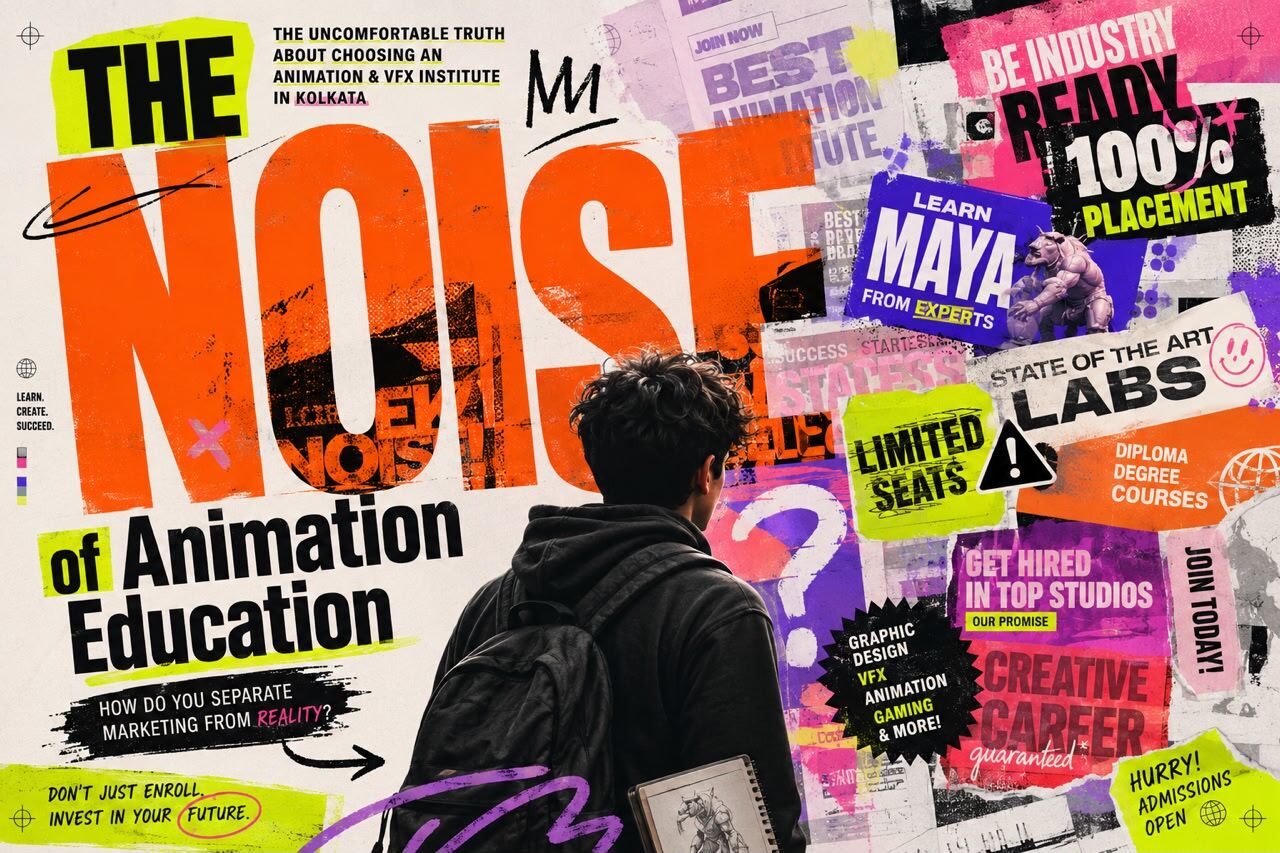
How to Choose the Best Animation and VFX Institute in Kolkata? A Prospective Student's Guide
| Quick answer: To choose well among animation, VFX, graphic design and game design courses in Kolkata, look past the marketing and verify six things — how long the specific centre has operated at its address, whether each subject has a dedicated specialist on faculty, what the lab machines can actually run, how “placement” is defined and evidenced, whether the work on screen was made by students or by a studio, and how many students share one batch. |
Search for the best animation and VFX institute in Kolkata and the results blur together. Almost every centre promises the same three things: 100% placement assistance, state-of-the-art labs, and industry-expert faculty. The wording is so similar that it tells a prospective student almost nothing.
There is a reason for that. Animation and VFX training is a high-demand category, and high demand attracts a wide range of operators — from institutes with decades of studio relationships to centres that opened recently and reused the same brochure language. When every claim sounds identical, the usual advice (“check the fees, tour the lab”) stops being useful. A sharper set of questions is needed.
One distinction is worth holding onto throughout. Newer or high-volume centres often teach software — which buttons to click in Maya or After Effects. Production-grade institutes teach pipelines — how a shot travels from brief to final frame, how to solve problems, and how to read a studio’s technical test. Studios hire artists who understand pipelines, not operators who memorised menus. That difference surfaces in every check below.
1. How long has this specific centre operated — at this address?
Ask this: When did this centre open at its current location, and who runs it day to day?
Brand age and centre age are not the same thing, and only one of them affects placement. A centre that has run continuously in one city for years accumulates something a new branch cannot copy quickly: an alumni network. Students from a decade ago are now mid-level artists, leads and hiring managers at the studios where today’s students want to work. That’s why a long, unbroken local history tends to predict warm introductions and faster callbacks — the pipeline already exists.
Local longevity also signals curriculum survival. An institute operating since the late 1990s has already navigated the shift from hand-drawn 2D to digital 3D, and more recently into real-time pipelines built on Unreal Engine. Surviving those transitions without losing teaching quality is itself a credential. It is also worth asking who owns and runs the centre — leadership rooted in the craft or in education tends to make different decisions than leadership managing purely by enrolment numbers.
Arena Animation Park Street is one local example of this kind of continuity: it has operated from 105 Park Street since 16 March 1998, has trained more than 6,000 students, and counts over 4,000 alumni placed across the industry.
2. Is each subject taught by a specialist, or by one person teaching everything?
Ask this: Who teaches each module by name, and what have they actually worked on?
A reliable signal of depth is specialisation. The skills behind a 2D animation course, a 3D animation course, a VFX course, a graphic design course, a motion graphics course, a UI/UX design course and a game design course are genuinely different disciplines. No single instructor is a working master of all of them.
When one all-rounder teaches graphic design, compositing, 3D modelling and motion graphics in the same week, it usually means the roster is thin — and the teaching stays at the level of surface mechanics. You learn to open the software; you do not learn the production workflow a studio test will ask for.
A practical benchmark when you audit faculty: each core discipline should have a dedicated specialist, ideally with several years of commercial studio work plus a few years of teaching. Ask for names and credits, not titles. At Arena Animation Park Street, for instance, modules are split across faculty with specific studio backgrounds — 3D and production taught by faculty credited at Xentrix Studios, DQ Entertainment and Netflix’s Mighty Little Bheem; 2D animation by faculty from the Chhota Bheem productions; VFX by faculty with feature credits including Robot 2.0; with separate specialists again for motion graphics and UI/UX.
3. Can the lab machines actually run the software?
Ask this: Can I open a real project and run a render or a simulation on a lab machine right now?
Modern animation and VFX software is resource-hungry. Maya, Houdini, Nuke and Unreal Engine all assume serious hardware. On an underpowered machine, a simulation that should take minutes takes hours, or crashes — and that lost time comes out of your learning.
A studio-style lab generally means current-generation processors, 32GB of RAM or more, and dedicated NVIDIA RTX graphics, with heavy 3D and design work in separate rooms rather than sharing one overloaded lab. You do not need to memorise specifications. You need to watch one machine do real work before you enrol.
4. What does “placement” actually mean here?
Ask this: Is there a dedicated placement person — and what share of graduates are placed, in what timeframe, under what conditions?
“Placement assistance” and a “placement record” are different promises. Assistance can be satisfied by forwarding a job link or uploading a reel to a national portal where it competes with thousands of others. A placement record is a stated outcome you can ask to see.
So ask two things. First, is there a dedicated placement person whose job is studio relations and portfolio review, or is placement outsourced to a central portal? Second, what share of graduates are placed, in what timeframe, and under what conditions?
A credible answer is specific and qualified. Arena Animation Park Street, for example, places around 90% of graduates who complete the curriculum and submit a portfolio within three months. The qualifier is the point: a placement rate quoted without conditions usually isn’t measuring anything.
5. Whose showreel are you watching?
Ask this: Can I see raw, unedited student project files from recent batches?
A counselling session sometimes opens with a high-energy reel of film and game VFX. It is worth asking a direct question: did students here make this, or is it a commercial studio’s reel? A montage built from Hollywood and AAA-game footage tells you what excites the counsellor, not what the institute can teach.
A transparent centre shows the opposite — actual project files made by students who sat in those labs a few months earlier, including work that has placed in national-level competitions. Recent, unpolished student output is far more informative than a flawless montage, because it shows the real ceiling of what you will produce. Arena Animation Park Street, for instance, shows prospective students raw project files from recent batches rather than a studio reel.
6. How many students share one batch?
Ask this: What is the batch size, and how often is my own work reviewed?
This is the quietest differentiator and often the most decisive. Animation and VFX are judged on a portfolio, and a portfolio improves through repeated, individual feedback. In a batch of thirty, that feedback is rationed. In a small batch, it is routine.
This is also where the volume model and the craft model separate most clearly. A centre optimised for enrolment fills large batches; a centre optimised for outcomes caps them. Arena Animation Park Street runs batches of eight — small enough that every student’s work is reviewed individually, which is the mechanism behind a strong placement rate rather than a slogan beside it.
The 7-minute campus-visit checklist
Take these six questions to your next campus visit. The point is not to catch anyone out — it is to replace identical marketing language with answers you can compare.
| Ask this | A strong answer sounds like |
| How long has this centre run at this address? | A specific year and a local alumni network — not just a brand’s founding date. |
| Who teaches each module, and what are their credits? | A different named specialist per discipline, each with real studio work. |
| Can I run a live project on a lab machine now? | Current processors, 32GB+ RAM, dedicated RTX graphics; no lag on a real render. |
| Is there a dedicated placement person, and what is the placement rate? | A named placement role, plus a specific, qualified percentage and timeframe. |
| Can I see raw student project files from recent batches? | Real, recent student work — some award-winning — not a studio showreel. |
| How many students are in a batch? | A small, capped number with individual portfolio review. |
Frequently asked questions
How do I choose the best animation institute in Kolkata?
Compare the six factors above — local operating history, specialist faculty, studio-grade hardware, a defined and qualified placement record, real student work, and small batch sizes — rather than comparing marketing claims, which tend to be identical across centres.
How much do animation course fees in Kolkata cost?
Fees depend on the programme’s length and specialisation: a short-term certificate costs far less than a multi-year career programme in animation or VFX. Ask any centre for a written, itemised fee structure before enrolling, and check whether financing is available — Arena Animation Park Street, for example, supports 0% EMI through Bajaj Finance and the West Bengal Student Credit Card. Fee and admission related information on our admissions page.
What is the difference between an animation course and a VFX course?
Animation is about creating motion and performance — characters, objects and cameras brought to life. VFX is about integrating digital elements into real footage through compositing, simulation and rotoscoping. They overlap, and many studios value artists who understand both, which is why some students combine the two.
Can I study graphic design, motion graphics or UI/UX instead of animation?
Yes. Alongside animation, VFX and game design, most full-range institutes offer design-led tracks — a graphic design course, a motion graphics course, a UI/UX design course and video editing — suited to students aiming at studios, agencies and product teams rather than animation pipelines. Arena Animation Park Street runs these as separate programmes.
Are “100% placement” claims reliable?
Treat “placement assistance” and a measured “placement rate” as different things. Assistance can mean little more than a forwarded job link. Ask instead for a specific, qualified placement percentage and the timeframe it covers.
How long does an animation or VFX course take?
Short-term courses run from a few weeks to a few months; full career programmes typically run one to three years depending on specialisation. The right length depends on whether you want a focused skill or a complete, portfolio-ready foundation for studio work.
What should I look for in the best animation colleges in Kolkata?
Note the distinction first: a college awards a degree, while a training institute such as Arena Animation Park Street awards industry diplomas and certificates focused on a job-ready portfolio. If your goal is studio employment, weigh placement outcomes and portfolio quality more heavily than the word “college” itself.
Where is Arena Animation Park Street located?
At 105 Park Street, Kolkata, near St. Xavier’s College in the Chowringhee area. The centre has operated there since 1998. Enquiries: +91 62898 96127.
How Arena Animation Park Street measures up
The six checks above are deliberately neutral, because that is how a useful guide earns trust. For readers already comparing options, here is how Arena Animation Park Street answers each one.
| The check | Park Street’s answer |
| Local operating history | Operating at 105 Park Street since 16 March 1998; over 6,000 students trained and more than 4,000 alumni placed. |
| Specialist faculty | A dedicated specialist per discipline, with credits at Xentrix Studios, DQ Entertainment, Netflix’s Mighty Little Bheem, the Chhota Bheem productions and Robot 2.0. |
| Studio-standard toolset | Students work on the tools studios actually use — Maya, Houdini, Nuke and Unreal Engine. |
| A qualified placement record | Around 90% of graduates who complete the curriculum and submit a portfolio are placed within three months. |
| Real student work | Recent, unedited student projects — some award-winning — shown on request, not a studio showreel. |
| Small batches | Eight students per batch, with every student’s work reviewed individually. |
Arena Animation Park Street also holds ISO 9001:2008 certification and has been recognised with WAVES Awards of Excellence (Ministry of Information and Broadcasting), administered by ASIFA India. It runs programmes in animation, VFX, game design, graphic design, motion design and UI/UX.
See the work before you decide. Prospective students can visit Arena Animation Park Street at 105 Park Street, Kolkata (near St. Xavier’s College), view recent student projects, and meet the faculty before enrolling. Enquiries: +91 62898 96127 · arenaparkstreet.com |


